Nexus Episode 8 Part I Review: How Beau Fipke and PJ Ace Built a Linear AI Sci-Fi Epic
PJ Ace (@PJaccetturo) opened his release thread for the newest Nexus installment with a striking claim: “This episode cost $102,725 and took 45 days to make. …but I think we’ve finally solved AI Filmmaking.” Running 4 minutes and 40 seconds in a 21:9 anamorphic frame, Nexus Episode 8, Part I justifies the ambition. Directed by Beau Fipke (@BeauChroma), written by PJ Ace and Dan Weller, and cut by Tyler Messervey with lead animation by Steven Quach (@directorquach) alongside animators Giulio Fulchignoni and Joe Sill, it feels less like a standalone tech demo and more like the opening act of a serialized adventure film.
You can watch the full episode and read the production breakdown in PJ’s release thread on X.
This episode cost $102,725 and took 45 days to make.
...but I think we've finally solved AI Filmmaking.
We made MAJOR breakthroughs in audio + cinematography.
And Part II (next week) is even more insane.
Steal our brand-new process and Dreamina prompts below👇🏼🧵
From anthology R&D to a connected story
For its first seven episodes, Nexus operated as an anthology. As PJ explains in the story notes of his thread, those earlier shorts served as public R&D to see which characters and worlds connected most with audiences. Episode 8 is where those threads converge into a continuous, multi-part narrative.
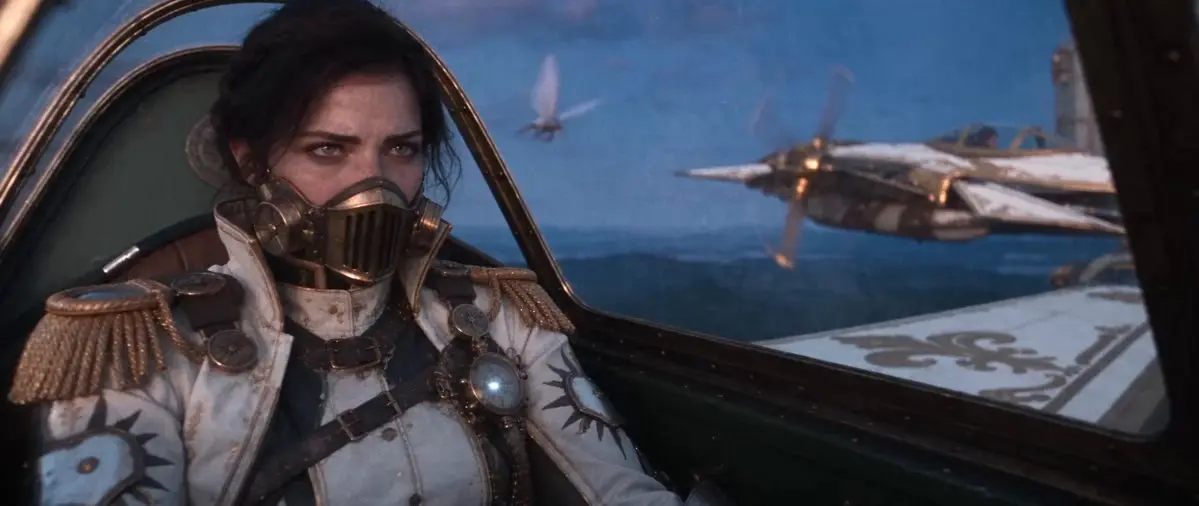
The story brings together Anika from Episode 1 (Wet Markets of Kafar) and Jace from Episode 4 (Squid Heist). Trapped aboard an Imperial prison ship and bound by matching black-and-gold wrist bracelets while an insectoid swarm tears through the vessel, the two have to slip out of their orange prisoner tunics, disguise themselves in mechanic jumpsuits, and find a way off the ship while stealing a vital resource from the Empire. Outside the hull, the scale widens into an homage to Hayao Miyazaki’s Nausicaä of the Valley of the Wind: white-and-gold Imperial flying-wing bombers and twin-boom Falcon fighters run a twilight bombing raid over ancient hive ruins in a misty conifer canyon, only to wake something colossal moving beneath the forest floor.
Bringing established leads into a shared predicament pays off right away. You do not need exposition to care about the escape because the world already has weight, and the two-hander chemistry between Anika’s dry, practical calm and Jace’s rapid-fire nerves gives the spectacle a human spine.
Anamorphic plates and long-lens discipline
The first thing you notice on screen is the glass. Generative video often defaults to a clean, spherical, everything-in-focus look that gives away its synthetic origins. Episode 8 Part I emulates vintage 2x anamorphic glass on 21:9 plates: shallow focus, subtle lens breathing, organic grain, and vertical oval bokeh in the background highlights. The sequence prompts write that target as 2.39:1 and native 21:9; the released episode frame is 2560×1080, about 2.37:1.
In his cinematography note, PJ points to the secret behind that texture: location plates come first. Before animating scenes, the team generated 21:9 background plates in Seedream 5.5 packed with anamorphic optical descriptors. Because video models inherit depth of field and optical character from their conditioning frames, locking the lens look into the location plate makes every downstream shot share the same camera package.
The flying sequence prompt shows how far the team pushed that camera discipline. Every cut in the 28-second bombing run is written for the same 100mm focal length—nothing wider—shot handheld as if from a chase plane door or from the damp pine needles of the canyon floor. Instead of relying on wide CGI-style establishing shots to show scale, the long lens stacks propellers, alien bugs, canyon mist, and the orange fireball into compressed layers, using rack focus and partial framing to make the machines and the subterranean ridge feel massive.
Pacing the cut across two registers
A scene-detection pass across the 262 seconds of story before the end credits counts roughly 112 cuts—an average shot length of about 2.3 seconds and a median of 1.6 seconds, with roughly three-quarters of the shots running three seconds or less. (Treat those numbers as approximate, since automated detection can over-count explosions and fast motion.)
What makes Tyler Messervey’s edit work is how clearly it separates the film’s two registers. The aerial combat and prison-break action move at a brisk clip, cutting on motion as bomb bay doors swing open and payloads drop vertically into the canyon. Inside the mechanic bay, the rhythm slows down to let scenes play in character time. Handheld shots track with Jace along a schematics table or push past his soft-focus shoulder onto Anika as she delivers the button of the scene—“I have a ship”—and holds the look for a full beat before the hard cut.
Dialogue, accents, and diegetic sound
PJ highlights audio as one of the episode’s major breakthroughs, and you can hear why in both the vocal performances and the restraint of the mix.
In the mechanic bay disguise scene, the prompt gives each character line-level accent, vocal register, and delivery cues: Anika speaks in a flat, low-alto General American register that never raises its volume, while Jace speaks in a warm working-class British Estuary voice that speeds up when he is anxious. When Jace tries to talk himself through the absurdity of their situation—“Okay. I don’t know you. You don’t know me. We’re stuck to each other and there are bugs eating people”—the humor lands because it is played as a breathless, unsmiling defense mechanism rather than a telegraphed punchline.
Just as impressive is what the sound design leaves out. The flying-sequence prompt explicitly specifies NO MUSIC and NO SCORE, while the mechanic-bay prompt specifies “No music” without NO SCORE. The sequences build tension entirely out of physical, diegetic layers: deep engine vibration, steam venting through brass valves, boots on metal, airframe rattle inside a cockpit, a respirator breath, and the low subterranean rumble of tree roots groaning in sequence as an armored body shifts the soil below.
Two-pass coverage without a 3D pipeline
Where Episode 7 (Dino Demolition Squad) leaned on Maya grayboxing for complex staging, PJ notes in his workflow breakdown that Episode 8 skipped 3D workflows altogether so a larger team of animators could move faster inside a shared canvas. In its place, they used a structured, ingredient-driven pipeline built around Claude and Dreamina:
- Wide, then deep on ingredients. Claude extracts every character, prop, and vehicle from the script for character sheets. The team explores wide variations in a canvas workflow before upscaling and locking high-resolution selects in Seedream 5.5.
- Two-pass scene coverage. Claude splits the script into scenes and 28-to-30-second multi-shot sequence prompts. In Pass 1, Seedance generates the full sequence across multiple angles to lock spatial geography and blocking. In Pass 2, the animators screenshot the strongest angles from Pass 1 and feed them back as anchors to get tighter close-up coverage and refined acting in those exact positions.
- Negative and continuity locks. The published prompts read like a continuity supervisor’s script notes. References are tagged with strict boundaries—
REFERENCE ONLY, NEVER A SHOT,GOGGLES LOCK,BRACELET LOCK,DIALOGUE LOCK—telling the model not only what a prop or scar looks like, but which shots it is forbidden to appear in and which hand or wrist it belongs on. - Subtext written as physical action. Instead of prompting abstract emotions, the direction breaks acting into observable beats: Jace’s gaze drifting to Anika’s healed back scars and his expression settling without pity or shock, or the Imperial pilot’s brief satisfaction fading as the orange blast reflection leaves his goggles.
What to take from it
- Bake the lens into the location plate. Generating 21:9 background plates with anamorphic depth-of-field characteristics gives every shot in a sequence a unified optical signature before animation begins.
- Use Pass 1 for blocking and Pass 2 for close-ups. Generating a multi-angle sequence first lets you discover and lock staging, then harvest frames to direct close-up performance without losing spatial continuity.
- Lock what the reference is not for. Annotating reference sheets with explicit exclusions (such as ignoring a held helmet on a character sheet or forbidding a reference frame from being used as a camera angle) prevents reference bleed.
- Let diegetic sound carry the scale. Stripping out wall-to-wall score in favor of cockpit rattle, venting steam, and shifting earth makes generated worlds feel tactile and dangerous.
With Parts II and III slated to drop over the next two weeks and a linear Season 1 finale planned for January, Nexus has found a repeatable studio model for episodic AI cinema. On the strength of Part I, the next chapter cannot get here fast enough.
For more on how Nexus has evolved, read our review of Dino Demolition Squad (Episode 7), our craft review of A Face Only A Mother Could Love, and our guide to planning an AI short film before the first generation, or explore the AI video experiments on this site.
Sources
- PJ Ace and Beau Fipke, Nexus Episode 8, Part I release thread (X, November 13, 2026), including the embedded 4:40 episode and end credits
- PJ Ace, notes on the Nausicaä homage and linear Season 1 structure (X, November 13, 2026)
- PJ Ace, breakdown of character sheets, Seedream 5.5 anamorphic location plates, and two-pass coverage, plus notes on anamorphic emulation and canvas orchestration (X, November 13, 2026)
- PJ Ace, mechanic bay disguise sequence prompt, flying bombing-run sequence prompt, and episode credits (X, November 13, 2026)
Scarlet Pictures’ own short films are on the films page.